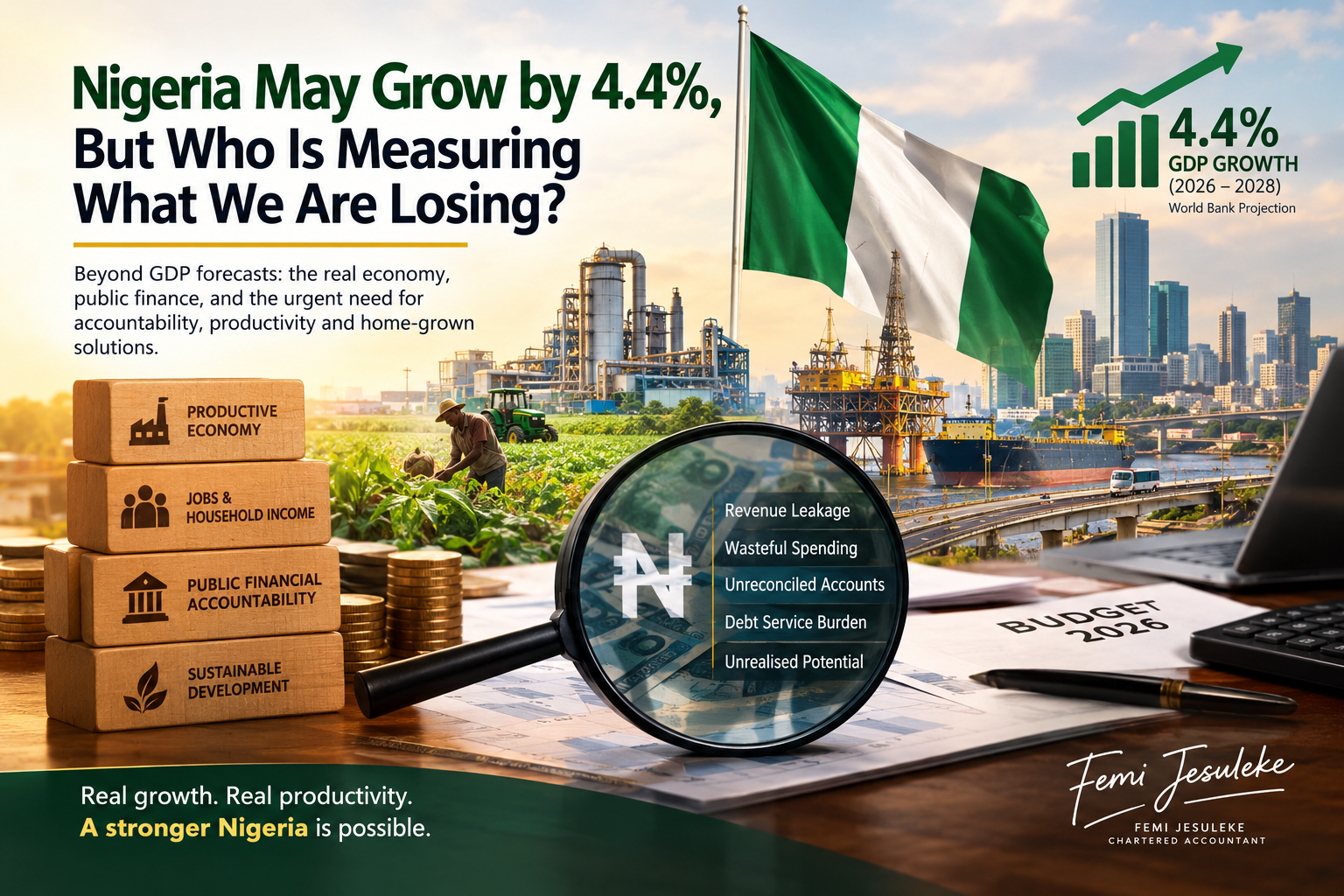
The World Bank projects that Nigeria’s economy will grow by an average of 4.4% a year between 2026 and 2028. This is encouraging. It suggests that the economy is becoming more stable and that recent reforms may be producing results.
But one question remains important.
What exactly is growing, and how much of that growth is reaching the people and businesses expected to sustain the economy?
A country can record positive GDP growth while factories struggle, businesses close, families lose purchasing power and government continues to borrow heavily. We should therefore avoid treating better economic indicators as automatic proof of better economic wellbeing.
The World Bank’s October 2026 Nigeria Development Update reports that real GDP grew by 4.2% in the first half of 2026, compared with 3.9% in the same period of 2025. Growth came mainly from services, with a stronger contribution from agriculture. These are positive developments, but they do not tell us whether Nigeria is becoming more productive.
Growth is important, but production matters more
Consider a Nigerian manufacturer operating a factory that employs 200 people. The business must buy diesel to support unreliable electricity, import some production inputs, finance inventory at high interest rates and move finished products over costly transport routes.
Even if GDP grows by 4.4%, what changes for that manufacturer if electricity remains unreliable, financing remains expensive and customers cannot afford the products?
The same question applies to agriculture. Higher output is welcome, but we should also ask whether farmers are producing more per hectare, whether post-harvest losses are declining, whether processing capacity is expanding and whether farmers can move produce to markets efficiently.
Nigeria needs growth that creates productive employment, improves output per worker, reduces the cost of doing business and increases real household income. We should measure these outcomes as seriously as we measure GDP.
Government revenue has increased. What has changed?
The World Bank reports that gross federation revenue increased by 69% in real terms between 2023 and 2025. Aggregate state government revenue increased by about 93% in real terms over the same period.
These figures already account for inflation. They indicate a real increase in government spending capacity, not merely a rise in the number of naira collected because prices increased.
The share of state expenditure going to capital projects also rose from 46% to 61%. That is progress worth recognizing. It also strengthens the case for accountability.
If state governments now have substantially more resources, Nigerians should see measurable improvements in roads, schools, hospitals, water supply and other essential services.
- How many economically important roads have been completed and independently verified?
- Are businesses receiving more reliable electricity?
- Are learning outcomes improving?
- How many communities have gained access to functioning healthcare facilities?
Higher revenue is not an achievement by itself. Its value lies in what it delivers.
Before we borrow more, can we account for what we already have?
Nigeria’s public finance debate often begins with a shortage of revenue. Government needs money for infrastructure, education, healthcare, security and other public services. The usual responses are to collect more tax, attract investment or borrow.
Another question deserves equal attention. How much of our existing resources is lost through weak financial controls, inefficient procurement, abandoned projects, poor collection systems and wasteful expenditure?
Not every irregularity is corruption. Some losses arise from poor systems, weak coordination or inadequate records. The economic consequences are still real.
The IMF’s 2026 Article IV report identified an estimated fiscal statistical discrepancy equal to 2.7% of GDP in 2025. The IMF said this could reflect spending not captured by the Office of the Accountant General of the Federation.
This does not mean that 2.7% of GDP was stolen. A statistical discrepancy is not automatic proof of fraud. It does, however, raise serious questions about the completeness, reconciliation and transparency of public financial information.
We cannot assume that removing waste would eliminate the need to borrow. But we should establish how much is being lost before deciding how much more citizens must contribute.
Debt service is competing with development
Nigeria’s approved 2026 federal budget is approximately ₦68.32 trillion, with ₦15.8 trillion allocated to debt service. That is about 23% of the budget.
The Federal Ministry of Finance says debt service is expected to take more than 40% of projected federal revenue in 2026. The IMF estimated that federal interest payments absorbed about 53% of federal revenue in 2025.
Borrowing is not automatically bad. Countries borrow to build infrastructure and finance investments that can generate future economic value. The real issue is what the borrowed money achieves.
Borrowing that finances reliable electricity, productive transport and commercially useful infrastructure can strengthen the economy. Borrowing that supports weak projects or repeated inefficiency leaves future generations with the debt but not the benefit.
Debt sustainability is not only about debt relative to GDP. It is also about the cost of debt, the government’s revenue and the economic value created by the borrowing.
Nigeria needs current and reliable public financial information
A business cannot make sound decisions using financial information that is incomplete, unreconciled or substantially outdated. The same principle applies to government.
The Office of the Accountant General should be able to produce timely and reconciled information on government receipts, payments, cash balances, liabilities and outstanding commitments.
The Office of the Auditor General should have the resources and independence required to verify public accounts, identify irregularities and track corrective action. The Central Bank should continue improving the timeliness and transparency of its financial and monetary reporting.
Technology now makes it possible to capture transactions as they occur, reconcile accounts daily, flag unusual payments and monitor budget execution. The underlying records should be current, traceable and available for authorized review.
A more useful scorecard for Nigeria
Nigeria should complement its traditional indicators with regular reporting on five areas:
- Productive capacity. Are factories producing more? Are agricultural yields improving? Is electricity becoming more reliable?
- Business sustainability. Are more businesses surviving and expanding? Is productive finance becoming more affordable?
- Employment and household income. Are we creating useful jobs? Are real wages improving?
- Public financial accountability. How much revenue is collected, remitted and spent? How many audit findings have been resolved?
- The return on public spending. Are roads reducing transport costs? Are power investments improving output? Are health and education programs delivering better results?
These measures would help distinguish genuine structural improvement from temporary gains driven by oil prices, financial inflows or higher government revenue.
The question Nigeria must answer
The World Bank’s 4.4% projection is an outlook, not a guarantee of prosperity. Even if Nigeria achieves it, we must still ask whether the economy is more productive, businesses are more competitive and households are better off.
We should assess positive economic news fairly. We should also examine the numbers beneath it and demand measurable results.
Nigeria’s future will not be determined by forecasts alone. It will be determined by what we produce, how well we manage our resources and how much of our national wealth becomes lasting economic opportunity.
Growth matters. But what we lose, what we waste and what we fail to produce matter just as much.