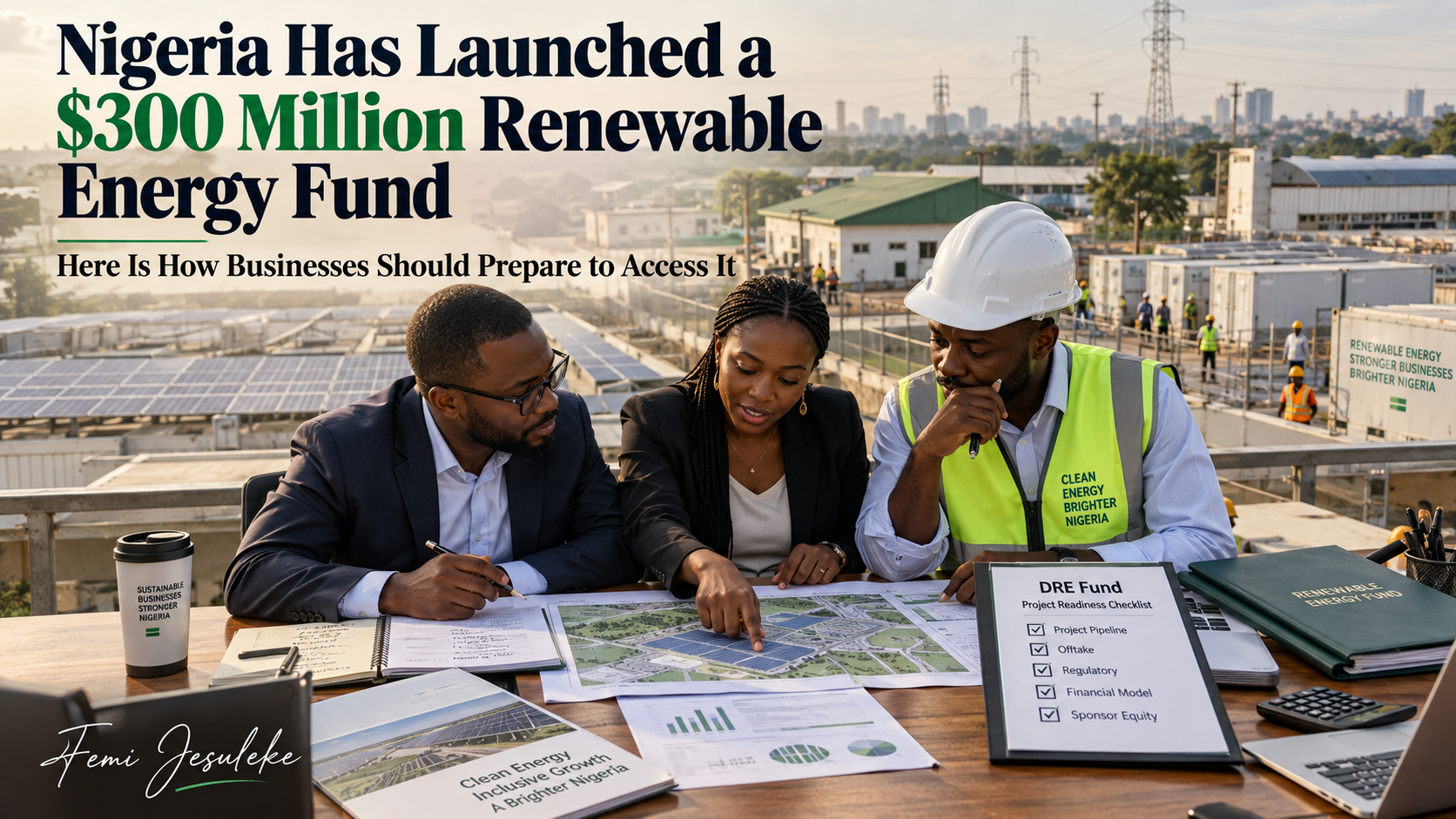
Nigeria’s power problem is well known. Businesses spend heavily on diesel, factories build private power systems and many schools, hospitals, markets and homes still operate without dependable electricity.
In September 2026, the Nigeria Sovereign Investment Authority, Africa50 and Sustainable Energy for All commercially launched the $300 million Nigeria Distributed Renewable Energy Fund. The World Bank is a founding partner and has committed an initial $25 million through the International Development Association.
The fund has moved from structuring into capital deployment. Reuters reported the commercial launch here.
The most important point for businesses is simple. This is an investment fund, not a general grant programme. Projects will need to show that they are commercially viable, technically credible and ready for institutional capital.
What the fund is designed to finance
The fund focuses on distributed renewable energy. This includes mini grids, standalone solar systems, decentralized power for underserved communities and energy systems that support productive businesses.
The opportunity is much broader than rural electrification. It can include industrial estates, markets, hospitals, schools, agricultural processors, cold storage, telecommunications, commercial buildings, housing estates and smaller factories.
Demand for power is not enough. Almost every Nigerian customer needs better electricity. The investment question is whether identified customers can and will pay for it over many years.
Investors finance dependable cash flow. They do not finance renewable technology simply because the need for electricity is obvious.
Local currency finance could remove a major risk
Many Nigerian energy projects earn revenue in naira but depend on dollar finance. When the naira weakens, the project continues to earn naira while the local cost of its debt rises.
The wider distributed renewable energy platform is intended to provide equity and local currency finance. This could reduce one of the largest risks in the sector and make tariffs more stable for customers.
The fund was initially announced as a proposed $500 million vehicle in March 2025. The vehicle commercially launched in September 2026 is $300 million. The original partnership announcement is available here.
Start with a real customer problem
A developer should not begin with the statement, “We want to build a solar project.”
The stronger starting point is specific. An industrial cluster consumes a known amount of power, spends a measurable amount on diesel, loses production during outages and is prepared to buy electricity under defined commercial terms.
The developer should know who the customers are, how much power they require, when they need it, what they currently spend and whether they can pay reliably.
Secure demand before chasing capital
A project becomes more credible when demand is documented. Evidence may include power purchase agreements, letters of intent, anchor customers or long term energy service agreements.
A proposal that says an area contains 5,000 businesses is weak. A proposal that shows verified demand of 4.2 megawatts and signed commitments representing 65% of expected revenue gives an investor something that can be tested.
Build a model that survives difficult conditions
The financial model should cover capital expenditure, operating costs, tariffs, customer growth, collection rates, technical losses, maintenance, insurance, tax, battery replacement, financing costs and foreign exchange exposure.
It should also show what happens if equipment costs rise by 15%, the naira weakens by 20%, customer demand is lower than expected, collections fall to 85% or batteries need replacement earlier.
A project that works only when every assumption is favorable is not ready for institutional capital.
Sponsors should expect to contribute equity
Developers should not assume the fund will finance the full project. Infrastructure investors normally expect sponsors and partners to contribute capital and share the risk.
Africa50’s general investment approach emphasizes credible partners, technically sound projects, economic impact and strong environmental, social and governance standards. The exact terms of the Nigeria fund may differ, but every sponsor should be ready to explain how much it will invest and why.
Regulation, land and technical delivery must be clear
Electricity regulation in Nigeria is becoming more decentralized. Depending on the project and its location, approvals may involve a state regulator, the Nigerian Electricity Regulatory Commission, environmental authorities, land agencies and rules for generation, distribution or mini grids.
Land ownership, leases, rights of way, access and community consent should be resolved before the project reaches an investment committee.
The technical plan must also show that the system can operate for its intended life. Investors will review the engineering design, contractors, equipment suppliers, warranties, maintenance arrangements and replacement plan.
Collections may matter more than generation
Nigeria has many locations where demand is clear. The harder question is often collection.
A project needs a credible payment system. This may include prepaid or smart meters, digital payments, automated controls, customer monitoring and clear credit rules.
For industrial projects, the developer must also assess the financial strength of each major customer. A large customer is not valuable if it cannot pay its electricity bill.
Governance will affect access to the fund
Institutional capital comes with due diligence. Developers should expect scrutiny of audited accounts, ownership, tax compliance, board oversight, financial controls, procurement and anti corruption procedures.
Environmental and social standards also matter. Projects should be ready to show how they will manage land, communities, health and safety, labor practices, waste, battery disposal and inclusion.
A strong project inside a poorly governed company can still fail to obtain finance.
Build the investment data room now
A serious developer should prepare the following documents before an application portal becomes the focus:
- project summary and demand study;
- customer commitments and tariff assumptions;
- site, land and regulatory documents;
- technical design and contractor proposals;
- financial model and stress tests;
- sponsor equity and proposed financing structure;
- audited accounts and tax compliance;
- environmental and social documents; and
- management and technical team profiles.
Build a capital stack, not dependence on one fund
The $300 million fund is not the only source of capital. Nigeria is also implementing the World Bank backed Distributed Access through Renewable Energy Scale Up programme, known as DARES. It has $750 million of financing and aims to provide new or improved electricity access to more than 17.5 million Nigerians.
A viable project may combine sponsor equity, fund equity, commercial debt, development finance, results based finance, grants for specific components and supplier credit.
Nigeria already has millions of customers spending money on generators, solar systems, transformers and captive power. The commercial opportunity is to turn that fragmented spending into investable electricity infrastructure.
Capital will not go to the company with the best solar presentation. It will go to the project that can turn reliable electricity into reliable cash flow.