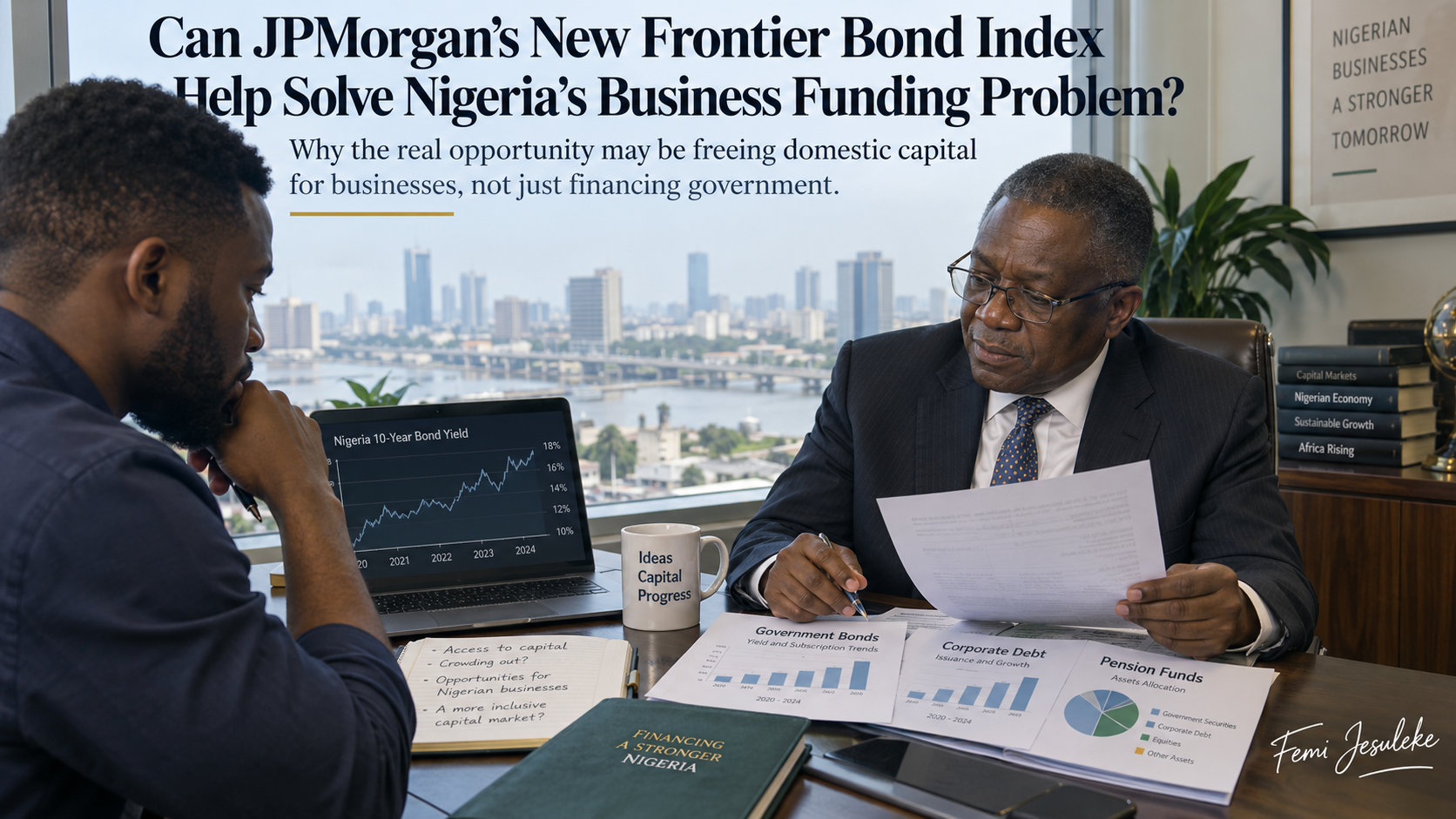
Nigeria has a funding problem. Government needs money. Businesses need money. Infrastructure needs money. Households need credit.
Yet much of the long-term capital available in the financial system continues to flow into government securities. That allocation is understandable. Government bonds are relatively low risk and can also offer attractive returns.
For businesses, however, this creates a difficult question. If a pension fund can earn a strong return from Federal Government securities, why should it lend to a manufacturer, property company or agricultural business that carries more risk?
This is one of the ways crowding out happens. A new development in global bond markets may create an opportunity to begin changing that equation.
What JPMorgan is launching
JPMorgan is preparing to launch a benchmark called the GBI-EM Edge by the end of September 2026. The index is expected to track nearly $330 billion of local-currency government bonds across 26 frontier economies. African countries will represent almost 45% of the index, with Nigeria, Egypt, Morocco and several other African markets included. Reuters reported the index details here.
There is an important point to clarify. This is not a $330 billion fund, and Nigeria is not receiving 45% of $330 billion.
The index is a benchmark. It gives international asset managers a recognized framework through which they can assess and invest in local-currency government bonds in frontier markets.
The direct beneficiaries are sovereign governments, not companies.
Nigeria’s Federal Government could benefit directly from stronger international demand for naira-denominated government bonds. Businesses benefit only if that demand changes how capital is allocated across the Nigerian financial system.
Why an index matters
Large international asset managers often invest against recognized benchmarks. Once a country’s bonds enter an index, portfolio managers have a clearer reason to study the market and, in some cases, hold the bonds.
That can increase visibility, investor participation, trading activity and market liquidity. For Nigeria, it could broaden the government’s investor base beyond local banks, pension funds, insurers and asset managers.
This raises the question that matters most to businesses:
If foreign investors fund more of Nigeria’s government borrowing, can Nigerian capital be released to finance businesses instead?
Potentially, yes. But it is not automatic.
Nigeria’s current funding problem
At the end of 2025, Nigerian pension assets stood at about ₦27.45 trillion. Approximately ₦16.33 trillion, or 59.5%, was invested in Federal Government securities. PenCom’s fourth-quarter dashboard provides the portfolio breakdown.
Pension managers are responsible for protecting retirement savings. Government securities offer liquidity, predictable income and lower credit risk than most corporate borrowers.
Banks face a similar decision. Why make a five-year loan to a business, carrying credit, collateral and recovery risks, when government securities offer attractive returns?
This helps explain why Nigeria can have trillions of naira in financial institutions while many businesses still struggle to find affordable long-term capital. Kenya faces a similar problem, as heavy government borrowing makes sovereign securities attractive and forces companies to compete with government for domestic savings.
Where the index could help
Today, much of the Federal Government’s naira funding requirement is met by Nigerian banks, pension funds, insurers and asset managers.
If international investors begin buying more Nigerian local-currency government bonds because those bonds are included in an international benchmark, part of the government’s funding could come from outside the domestic savings pool.
That could reduce pressure on local institutions and give them more room to allocate capital to:
- corporate bonds;
- infrastructure debt;
- mortgages;
- project finance;
- private credit; and
- other productive assets.
This would be the crowding-in effect. The index itself does not fund Nigerian companies, but it could help create conditions in which more domestic money becomes available to them.
What a small shift could mean
Nigeria does not need pension funds to abandon government securities. That would neither be realistic nor desirable. Even a modest, gradual reallocation of the ₦16.33 trillion held in Federal Government securities could be significant.
5% reallocationApproximately ₦817 billion could become available for other suitable investments.
10% reallocationApproximately ₦1.63 trillion could move into productive assets.
15% reallocationApproximately ₦2.45 trillion could support a wider range of corporate and infrastructure financing.
These amounts could support major investments in manufacturing, power, healthcare, logistics, mortgages and corporate expansion. They also exclude banks, insurance assets, mutual funds, sovereign institutions, family offices and other pools of Nigerian capital.
The bigger opportunity is to use foreign participation to create more room for Nigerian capital to finance the productive economy.
The risk of simply making government borrowing easier
The opposite outcome is also possible. Foreign demand could simply make it easier for government to borrow more.
If government continues borrowing heavily from pension funds and banks while also attracting foreign investors, the market becomes larger but businesses do not necessarily benefit. Crowding out continues.
Nigeria should therefore avoid treating new foreign demand as permission to increase borrowing indefinitely. The objective should be to diversify who finances government, not simply increase how much government borrows.
A better yield curve can also help businesses
A deeper and more liquid government bond market gives Nigeria a clearer sovereign yield curve. This matters because corporate bonds are usually priced relative to government bonds of similar maturity.
A five-year corporate bond, for example, can be priced using the five-year government bond yield plus an additional spread for the company’s credit risk.
That gives investors a clearer way to price risk. Over time, a better sovereign yield curve can support corporate bonds, infrastructure bonds, mortgages, project debt and private credit.
Foreign capital can also leave
International investors buying naira bonds carry currency risk. If global rates rise sharply, confidence in Nigeria weakens or investors become nervous about emerging markets, they can sell their bonds and convert the proceeds into dollars.
That can place pressure on bond yields, the naira and foreign reserves. Nigeria should not replace dependence on domestic investors with dependence on foreign investors.
A resilient market needs a diverse base of foreign investors, pension funds, insurers, banks, asset managers and retail investors.
How government and regulators should prepare
Nigeria needs predictable bond issuance, liquid benchmark securities and transparent market rules. International investors will pay close attention to foreign exchange convertibility, settlement, taxation, custody, repatriation and hedging.
If any of these are difficult or unpredictable, investors will demand higher returns. Fiscal discipline is equally important. If foreign participation grows, part of that demand should reduce the pressure placed on domestic institutions. Otherwise, businesses may see little benefit.
How pension funds and insurers should prepare
Institutional investors should continue developing frameworks for investing in productive assets. This does not mean abandoning government securities, which remain important for liquidity and portfolio stability.
It means building the capacity to assess investment-grade corporate bonds, infrastructure bonds, securitized assets and private credit. Regulation matters, but Nigeria also needs a larger pipeline of well-structured, investable assets.
Companies also need to prepare
Many businesses complain that institutional capital is unavailable, but many companies are not ready to receive it.
A pension fund cannot invest billions simply because a company has a good business idea. It needs audited financial statements, credible governance, predictable cash flow, strong boards, proper treasury management, credit ratings and a clear use of proceeds. Companies must also report consistently after the money has been raised.
If pension funds, insurers or international investors wanted to lend to us tomorrow, are we ready to issue a bond?
For many companies, the answer today would be no. That has to change.
Banks will need a broader business model
A deeper capital market changes the role of banks. Banks can earn more through underwriting, custody, market making, bond trading, structured finance, foreign exchange services, hedging and corporate debt origination.
This would allow them to remain central to the financial system even as more companies access capital markets directly.
The bigger opportunity for Africa
JPMorgan’s new index is initially about sovereign bonds. Governments benefit first, but sovereign bonds should not be the final destination of this market development. They should be the foundation.
A functioning government bond market creates the benchmark from which investors can price corporate bonds, infrastructure debt, mortgage securities, project finance and private credit. That is how the development becomes useful to businesses.
The ideal sequence is clear:
JPMorgan’s frontier index will not solve Nigeria’s corporate funding problem on its own. It could, however, create an important part of the solution.
The real opportunity is not that Nigeria can borrow more. It is that Nigeria may be able to change who finances government and create more space for domestic capital to finance the economy.
If foreign investors arrive and government simply borrows more while domestic institutions remain heavily concentrated in government securities, very little changes for businesses. Nigeria would simply have built a larger market for financing government.
The real test is whether the opportunity helps build a deeper market for financing businesses, infrastructure and productive investment. That is the outcome that would matter to the economy.