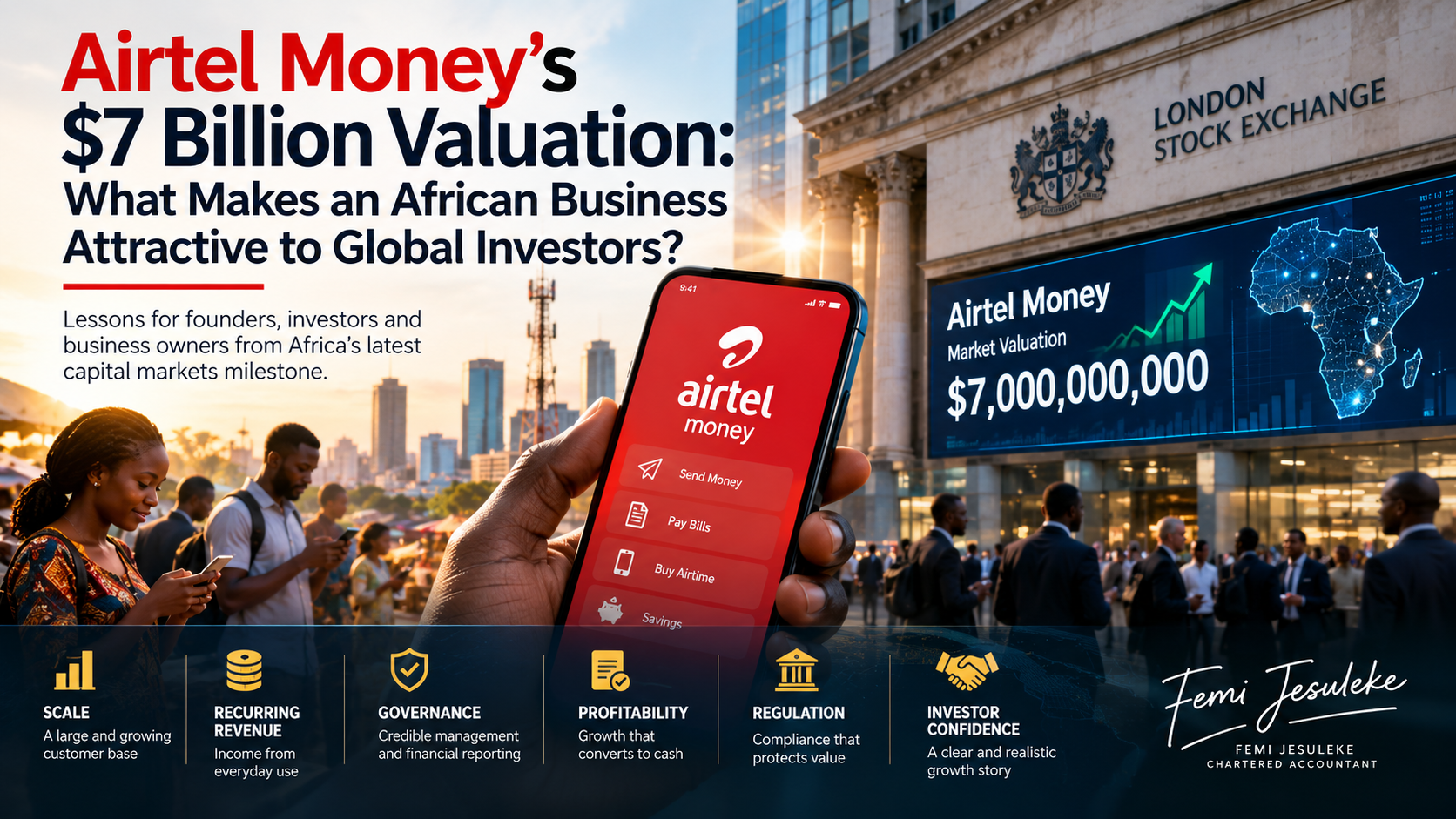
Airtel Money began trading on the London Stock Exchange on 9 October 2026 at an offer price of £1.96 per share. That price gave the company a market value of about £5.3 billion, approximately $7 billion at the time.
Reuters reported that existing shareholders sold about $703 million of shares. The shares closed around £1.93 on the first trading day.
For African founders and business owners, the important question is not simply how much Airtel Money is worth.
What makes investors willing to place a multibillion dollar value on one African business while many others struggle to raise the capital they need?
The answer involves scale, but it also involves the quality of earnings, the strength of management, regulatory standing and the confidence investors can place in the company’s future.
A large market is an opportunity, not a valuation
Africa has a large and growing population. Millions of people need financial services, housing, healthcare, electricity, transport, education and consumer products.
That demand creates business opportunities. It does not automatically create valuable companies.
Investors want to know how much of the market a company can serve, what it costs to serve each customer and whether growth will produce sustainable profit.
A company operating in five countries may be larger today than a focused business in one country. But the smaller business may be more attractive if it retains customers, generates reliable cash and can expand without costs rising at the same rate as revenue.
The lesson for founders is simple. A large addressable market attracts interest. A business that can earn sustainable returns from that market attracts investment.
Why recurring revenue matters
Financial service customers transfer money, receive funds, make payments and transact with merchants regularly. Each transaction may produce a small amount of revenue, but millions of repeated transactions can create a substantial business.
Investors generally prefer revenue they can estimate with reasonable confidence.
A company earning ₦500 million from one contract faces a different risk from a company earning the same amount through thousands of customers who make regular purchases. The first company must replace a large contract when it ends. The second has a broader revenue base, provided its customers remain active and each transaction is profitable.
Recurring revenue is not automatically good revenue. Technology, fraud prevention, regulation, customer acquisition and transaction processing all cost money. Investors will ask how activity becomes actual earnings and cash.
The same principle applies outside financial services. A logistics company can secure long term delivery contracts. A healthcare provider can serve corporate clients. A software company can earn subscription income. An equipment supplier can add maintenance and service contracts.
Growth must eventually produce cash
A company can grow revenue quickly and still destroy value if customer acquisition, service delivery and financing costs rise faster than income.
Investors may accept lower profit while a company expands, but they need credible evidence that scale will improve the economics of the business.
Revenue, accounting profit and operating cash flow are different measures. A company may report ₦5 billion of revenue and ₦600 million of profit but struggle to pay suppliers because customers have not paid. Another company may report lower profit but generate stronger cash because collections and working capital are well managed.
Investors will examine operating margins, customer profitability, cash conversion, capital expenditure, debt obligations and the cost of acquiring and retaining customers.
Do not build a business that looks successful only when measured by sales. Build one whose financial performance can withstand serious review.
Good governance protects business value
A founder may have built a successful company over many years. But an investor must be able to verify the company’s financial position and understand how it is run.
Due diligence will ask practical questions:
- Are the financial statements reliable?
- Are company and personal expenses properly separated?
- Are related party transactions documented?
- Who can approve major spending?
- Are tax and regulatory obligations current?
- Can the company operate effectively without the founder making every decision?
Weak answers increase uncertainty. That can reduce the price an investor will pay or prevent the investment entirely.
Strong reporting, clear ownership, effective controls and accountable management make a company easier to value, finance and expand.
Regulation can protect value or destroy it
Airtel Money operates in a highly regulated sector. Customers trust financial service companies with their money, data and transactions.
Licensing, capital requirements, consumer protection, anti money laundering controls, data protection and the treatment of customer funds all matter to investors.
A profitable business can lose substantial value if its license is suspended or serious compliance failures emerge. The same principle applies to pharmaceuticals, energy, construction and other regulated industries.
Compliance is not merely an expense. It protects the company’s ability to continue earning revenue.
The future matters more than the past
Historical performance provides evidence, but investors buy an interest in future earnings.
Two companies with similar current profit can receive different valuations. One may have limited growth prospects. The other may have a credible route to new markets, additional products, better margins and more customers.
A forecast of 40% annual growth is not persuasive by itself. Management must explain where the customers will come from, what it will cost to serve them, how the expansion will be funded and when the growth will generate cash.
The $703 million share sale did not give Airtel Money $703 million
The London Stock Exchange confirms that all shares offered in the listing were sold by existing shareholders. Airtel Money did not issue new shares and did not raise fresh money from the offer.
This is a secondary share sale. The investors paid the shareholders who sold their shares. The company gained a public market for its shares and a broader ownership base, but the sale proceeds did not enter its bank account.
A primary capital raise is different. In that case, the company issues new shares and receives the money for expansion, equipment, technology or working capital. Existing shareholders usually own a smaller percentage after the new shares are issued.
Both transactions can be useful, but they achieve different objectives. A large public offering does not necessarily mean that the operating company received an equal amount of new capital.
What the valuation tells us
A valuation is what investors are willing to pay for ownership at a particular time. It is not the company’s revenue, profit, assets or bank balance.
The London Stock Exchange says Airtel Money serves about 53 million monthly active users across 13 African countries through more than 2.3 million agents. That scale helps explain the investor interest.
But a $7 billion equity value should not be treated as proof that every African fintech deserves a similar valuation. Investors consider future cash flows, growth, risk, debt, cash balances and the prices of comparable companies. Each business must be assessed on its own fundamentals.
Five questions for African founders
- Can we explain clearly how the company makes money? Show the profit and cash earned after the full cost of delivering the product or service.
- Can an independent investor trust our financial information? Accounts should be reliable, reconciled and supported by records.
- Can the company grow without losing financial control? Expansion should improve earnings, not only increase working capital and overhead.
- Can the business operate without depending entirely on the founder? Capable managers, clear responsibilities and documented processes matter.
- Do we know what the capital will achieve? State how much is needed, where it will be spent and what return it should produce.
The first trading day also carries a lesson
Airtel Money closed at about £1.93 on its first trading day, slightly below the £1.96 offer price. A successful listing does not guarantee that the share price will keep rising.
Investors continue to assess performance, competition, interest rates and economic conditions after a company lists. A valuation is not a permanent certificate of success. Management must continue earning investor confidence.
The lesson for African businesses
Airtel Money’s listing shows that a business serving African customers can reach significant scale and attract international investment.
The deeper lesson is not that every company needs a London listing. It is that serious capital is attracted to businesses whose earnings can be understood, whose financial information can be trusted and whose growth plans are supported by evidence.
The challenge is not simply to build a bigger business. It is to build a business whose value can be understood, verified and sustained.